

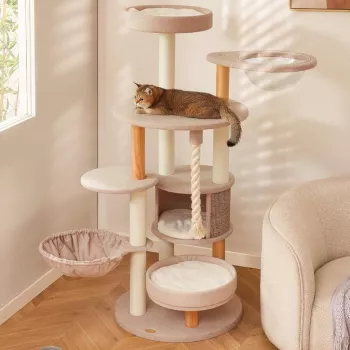
Habitats Tree Scratchers Tower for Indoor Cat Routines

Habitats Tree Scratchers Tower: Climbing, Scratching, and Resting Space for Indoor Cats
A sturdy scratching tower gives cats a dedicated place to stretch, claw, climb, and lounge—while helping protect furniture and creating predictable routines in a multi-pet home. The right setup becomes part of everyday life: a “morning stretch” station, a midday nap perch, and a safe place to watch the room from above. Below is what matters most in a tall scratching tree, how to place it for real daily use, and what to look for in materials, stability, and care.
What a tall scratching tower adds to a cat’s daily routine
- Supports natural scratching behavior: Scratching helps cats mark territory, shed nail sheaths, and stretch the shoulders and back in one satisfying motion. A tall surface makes the stretch feel “complete,” which often makes the tower more rewarding than a couch arm.
- Adds vertical territory: Cats often feel more secure when they can get up off the floor. Extra vertical “real estate” can reduce stress and tension in multi-cat homes by increasing usable space.
- Encourages movement: Short climbs and hops between platforms add low-effort exercise for indoor cats—especially when the tower is near a window or paired with a quick play session.
- Creates a predictable rest zone: A consistent perch gives a cat a reliable spot to decompress, nap, and observe household traffic without being in the middle of it.
For more enrichment ideas that fit indoor lifestyles, see the ASPCA’s cat enrichment guidance.
Habitats Tree Scratchers Tower at a glance
The Habitats Tree Scratchers Tower is built to function as a vertical scratching-and-perching hub for indoor cats. It’s a practical option when the goal is to redirect scratching away from rugs, sofa corners, and door frames, while also giving your cat a destination for climbing and resting.
Like most scratcher training tools, it works best when it’s placed where your cat already wants to be—near a main living area, a favorite window, or close to the current “hot spot” your cat has chosen for scratching.
Quick comparison: common scratching setup options
| Option | Best for | Watch-outs |
|---|---|---|
| Tall scratching tower | Climbing + full-body stretch scratching + perching | Needs stable base and enough floor space |
| Vertical scratch post | Straightforward scratch training in small spaces | May not satisfy climbers or high-perch preferences |
| Horizontal scratcher | Cats that prefer low scratch angles; seniors | Can be ignored if the cat wants vertical stretch |
| Wall-mounted scratch/perch | Saving floor space; building a vertical pathway | Requires secure mounting and planning layout |
Key features to prioritize before buying
Where to place a scratching tower for maximum use
International Cat Care emphasizes how valuable vertical space can be for indoor cats; their overview of environmental needs is a helpful reference for setting up a calmer home: https://icatcare.org/advice/indoor-cats/.
Helping a cat switch from furniture to the tower
- Make the tower the easiest option: If the sofa corner is the “chosen spot,” place the tower closer than the corner—at least initially—so it wins on convenience.
- Use positive reinforcement: Reward immediately after your cat scratches the tower (treat, quick play, or calm praise). Timing matters: aim for within a couple seconds of the scratching.
- Use attractants carefully: Catnip or silvervine can help, but not every cat responds. If your cat does, rotate attractants occasionally to keep the tower interesting.
- Reduce the appeal of forbidden surfaces: Temporary protective covers or double-sided tape can interrupt the old habit while a new routine forms. The Humane Society’s scratching behavior resource includes practical approaches to protect your home during the transition: https://www.humanesociety.org/resources/cats-destructive-scratching.
- Offer the right scratching angle: If your cat prefers vertical scratching, ensure the main scratch area is tall enough for a full stretch—front paws up, shoulders extended, back lengthened.
Care, upkeep, and safety checks
Who it suits best
Featured picks available now
- Habitats Tree Scratchers Tower — A dedicated vertical hub for scratching, climbing, and everyday perching.
- Meaningful Conversation Starter Guide (Printable) — A handy add-on for households that host guests often, helping keep attention on people (and not on the cat testing the furniture).
FAQ
How tall should a scratching tower be for an adult cat?
Aim for a main scratching surface that lets your cat fully stretch upward without crouching. Larger cats typically do better with taller posts and a very stable base, and multiple platform levels help them choose comfortable resting heights.
What if the cat ignores the scratching tower?
Move it near the current scratching spot, reward immediately when it’s used, and use play to guide your cat onto the tower so it becomes part of a fun routine. Catnip or silvervine can help (if your cat responds), and temporarily covering the old target surface can make the new option more appealing.
Is sisal or carpet better for scratching?
Many cats prefer sisal because it’s grippy and durable, and it tends to hold up well to frequent use. Carpet can be appealing too, but it may confuse the rules if your home carpeting is off-limits, so matching your cat’s preference (or offering multiple textures) often works best.













Leave a comment